







New Flash Battery patent: BMS with impedance spectrum for predictive battery management
7 April 2026

2026 has opened with new milestones for our company. Among these is a new patent related to the evolution of the Battery Management System (BMS), a key element for the safety and performance of lithium batteries. We asked Alan Pastorelli, co-founder and CTO of Flash Battery, to explain how this new system works and what tangible benefits it brings for OEMs and system integrators in industrial electrification.
An evolution built on the Flash Balancing System
The starting point is our Flash Balancing System, the technical solution that has defined Flash Battery systems for years.
The first patent, filed a few years after the system was introduced to the market, protects the distinctive architecture our battery BMS is based on:
- Centralised power devices (master)
- Distributed electronics (slave)
- A shared power connection across all cells.
This architecture enables high-power balancing, improving cell uniformity, pack lifespan and overall performance.
The new patent is designed to integrate an advanced measurement capability by leveraging the BMS architecture: the measurement of cell impedance and impedance spectrum.

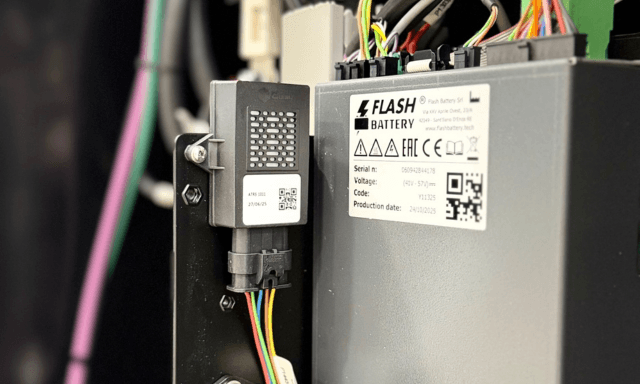
Testing and validation of BMS electronic components in the laboratory, essential for developing new advanced features
Impedance: a known parameter, a new challenge
Our CTO, Alan Pastorelli, explains: "Impedance is an electrical parameter, just like voltage and current. Measuring it means quantifying how a cell responds to a variable electrical stimulus."When we talk about impedance spectrum, we mean a series of measurements taken at different frequencies, providing a true “electrical signature” of the cell. This signature changes over time and reflects the internal state of the battery."
The technique is known as EIS - Electrochemical Impedance Spectrum and is widely used in laboratory environments, including outside the battery sector. A well-known example is bioimpedance, used to measure body fat mass.
The real challenge is therefore not the measurement itself, but taking it out of the laboratory and making it:
- Integrable into the BMS
- Reliable in real-world conditions
- Sustainable in terms of cost, size and robustness
And this is precisely where our patent focuses. Why the impedance spectrum is strategic for the BMS
The impedance spectrum is one of the most advanced methods for analysing the internal behaviour of cells. Integrating it directly into the BMS.

Simplified impedance spectrum (EIS) chart (EIS) [1]
State of Health: how to assess battery lifespan
State of Health (SoH) indicates how much of a battery’s useful life remains.
It’s expressed as a percentage:
100% = new battery
Lower values = progressive degradation over time
In practice, SoH never reaches zero. The battery ceases to be suitable for the application it was designed for much earlier.
A concrete example? The mobile phone we all carry in our pockets: when the battery starts to offer only a few hours of autonomy, we replace it (or change the device altogether).
In the automotive sector, for example, a residual capacity of 80% is often considered the functional end-of-life threshold. In applications such as energy storage, where autonomy is less critical, this threshold can be lower. But it’s not just about identifying a number.
As Alan Pastorelli points out: “The key point is the ability to reliably determine where the battery stands today along its lifecycle”.
This makes it possible to: verify whether actual behaviour is consistent with initial expectations. Estimate remaining life based on real usage. Plan investments and replacements in advance.
In other words, this system enables a shift from a reactive approach to planned battery fleet management.

Battery data analysis through advanced monitoring systems, underpinning the development of predictive models for the BMS
Impedance measurement in the BMS: the hardware challenge
The core of the patent lies in the hardware: developing a BMS capable of measuring impedance accurately and repeatably, directly on board the battery.
While this measurement is already possible in laboratory environments, real-world applications introduce stringent constraints:
- Costs
- Space
- Reliability
The difficulty in real applications is further increased because the impedance values to be measured require extremely high sensitivity, particularly given the high capacity of the cells.
The patent focuses precisely on how to leverage the BMS architecture to make this functionality technically and economically viable for real industrial applications.
From laboratory to field: real data for predictive models
Alongside conceptual development, we are already working on experimental testing:
- In the laboratory, by artificially ageing cells and monitoring them over time
- In the field, by analysing batteries operating under particularly demanding conditions
Applications such as those of E80 Group, operating 24/7 and characterised by rapid charging, provide an ideal case: they enable the collection of large volumes of data in shorter timeframes.
Access to data from thousands of connected batteries collected through our Flash Data Center allows us to develop increasingly robust models and validate the correlations between impedance, degradation and safety in the field.

E80 Group LGV vehicles powered by Flash Battery lithium batteries, designed to operate in high-intensity industrial environments 24/7

Bibliography
[1] https://lithiuminventory.com/experimental-electrochemistry/eis/index.html