







Active safety in lithium batteries: gas sensors
19 November 2025

When it comes to industrial lithium batteries, safety is one of the central issues. In the world of industrial applications, where machines often operate continuously and autonomously, the safety of lithium batteries is not optional but rather a fundamental requirement. This is even more relevant when considering the range of chemistries available on the market: not all lithium solutions offer the same level of stability.
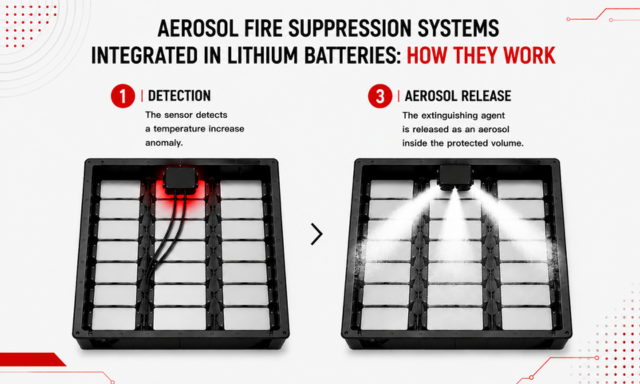
For this reason, at Flash Battery we have chosen to offer the option of integrating additional safety measures such as gas sensors and extinguishing systems built into the battery that are capable of detecting early warning signs and acting proactively to address them.
Not all lithium batteries are the same: several chemistries exist, each with different characteristics in terms of energy density, lifespan and above all thermal stability and intrinsic safety.
Some, such as NMC (Nickel-Manganese-Cobalt) lithium cells, provide high energy density but also carry a higher intrinsic risk of thermal instability, especially under extreme operating conditions or in the event of a malfunction. Under abnormal stress (such as short circuits, impacts or overloads), these cells may experience dangerous phenomena such as thermal runaway, a chain reaction that leads to the rapid release of gas and heat, with potential risks of fire or explosion.
By contrast, the LFP (lithium iron phosphate) chemistry adopted by Flash Battery stands out for its far more stable and predictable behaviour, even under stress. In fact, LFP cells have a high decomposition temperature and are less prone to thermal instability, a combination that ensures a high level of safety even in the event of an internal short circuit.
However, while LFP cells are intrinsically very safe, as with all types of energy storage the risk is never zero. For example, a hot spot may develop due to improper tightening, which could ignite the sheath of a cable or surrounding plastics.
For this reason, battery safety must be addressed with an integrated approach that combines the selection of a stable chemistry, advanced electronic design and intelligent monitoring and response systems.

Comparison chart between LFP and NMC chemistry in terms of safety, decomposition temperature, and heat release
In the world of lithium batteries, safety cannot be an afterthought, but must be a guiding principle integrated from the very earliest design stages. This is why the manufacturer plays a decisive role in defining the safety level of a battery pack, and this process begins as early as the research and development stage, where technical criteria, chemistries and protection logics are defined.
The process then moves into design, which must follow specific criteria, and continues with the selection of the most suitable materials and the actual assembly of the battery pack. Choosing a lithium-battery manufacturer with experience and the right know-how is therefore critical to ensuring the safety of industrial machines. Behind a finished battery pack lies a truly complex world of study, research and development, technical testing and above all careful selection of components and electronics, factors that – besides influencing the performance of the application – are essential to ensuring a lithium battery is safe and reliable over time.
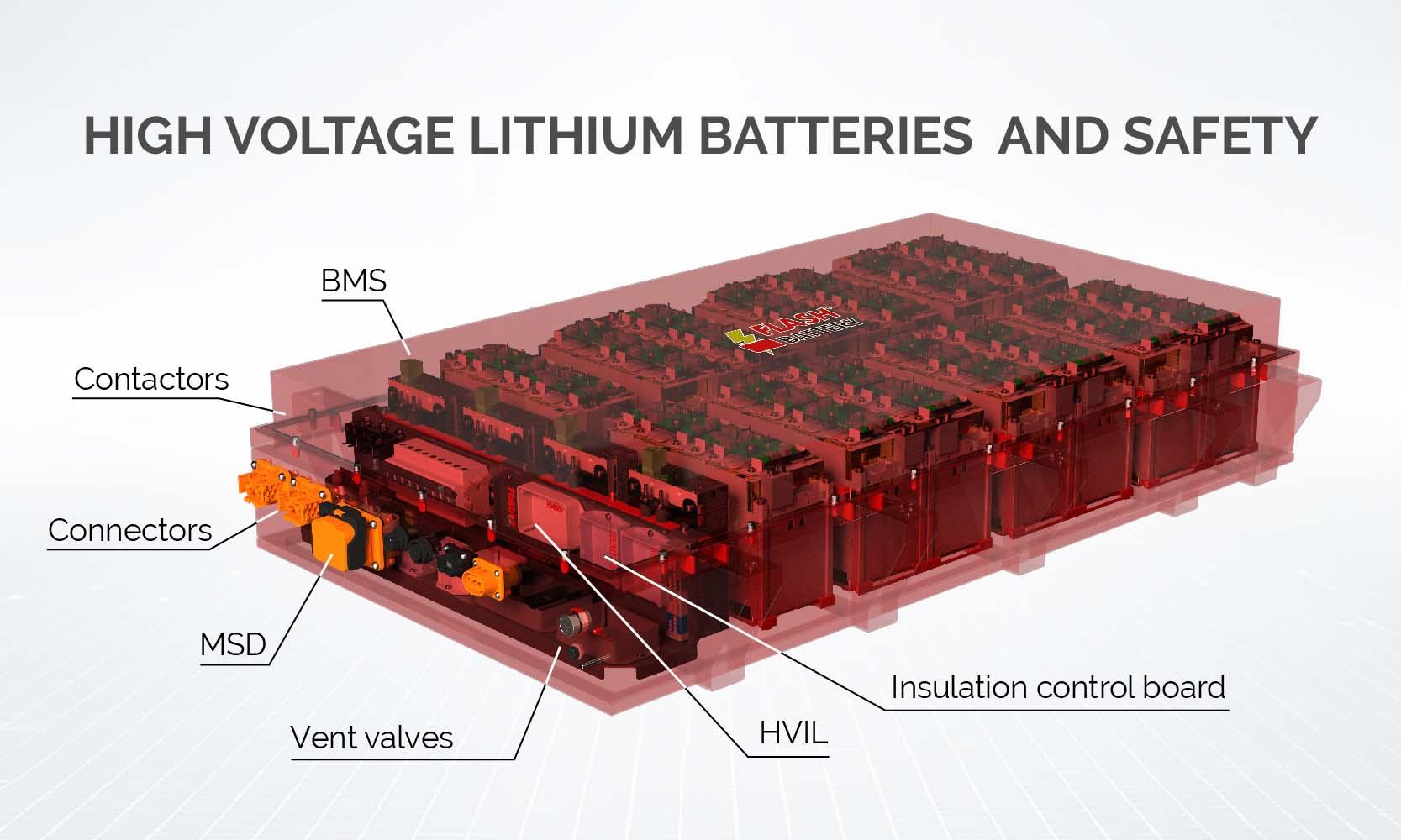
One of the central elements in this architecture is the BMS (Battery Management System), which does far more than read data: it communicates constantly with the vehicle and the charger, monitoring the voltage, temperature and state of health of each individual cell in real time. In the event of anomalies, the BMS can interrupt charging and discharging, act on the contactors and isolate the battery to prevent any operational risk.
Overheating is one of the main issues to prevent to ensure the safety of a lithium battery, and to achieve this constant monitoring of the battery’s internal temperature becomes essential. One of the various functions of an intelligent BMS is precisely this: ensuring the constant checking of the temperature and the voltage of individual cells, to interact with the vehicle and with the battery charger in order to stop it from charging and discharging in the event of a critical issue and to trip the main contactors.

Diagnostic tests on electronic boards to ensure the reliability of battery management systems

Gas sensor applied to a lithium battery for the industrial sector
"The integration of gas sensors and aerosol fire suppression systems adds a layer of active safety that allows abnormal scenarios to be managed in a technically sound manner. Early gas detection provides a few extra critical minutes to act before a cell goes into thermal runaway, while the aerosol ensures rapid, localised containment without compromising the electronics. These solutions are designed for those who need to ensure operational continuity, reduce the risk of failure and maintain high safety standards across the entire vehicle system."

Gas sensors make it possible to detect the formation of volatile electrolyte gases that may escape from a damaged cell well before obvious symptoms appear, such as rising temperatures or visible smoke.
In the event of overheating or an internal short circuit, various specific gases may be generated inside the battery pack from the decomposition of materials in the cell such as hydrogen, carbon dioxide, carbon monoxide and other vapours from liquid electrolytes.
These gases are a sign of an early stage of cell damage, even before visible smoke or the onset of full thermal runaway, and therefore represent a signal that cannot be ignored.
This is where gas-detection sensors come into play and why they can make the difference in determining the safety of a battery pack.

The different stages of the increase in the internal temperature of a lithium-ion battery and the related chemical reactions [1]
As soon as gas is detected inside the battery pack, this device communicates in real time with the Battery Management System (BMS), which interprets the signals and can trigger targeted actions: notifying the vehicle of the anomaly, actively cooling the modules, activating extinguishing systems or sending alerts to the control centre.
Unlike traditional thermal sensors, which only signal an anomaly after the temperature has exceeded critical thresholds, gas sensors make it possible to gain precious time to activate countermeasures and prevent more serious consequences such as thermal runaway.

Example of a cell test: the gas sensor detects emissions 12 minutes before the temperature alarm, allowing early identification of the thermal-runaway risk. Cell brought to thermal runaway and gas-sensor operation
In the chart above, a cell was overloaded until it reached thermal runaway. As can be seen from the temperature line, at minute 4:30 the cell opened its safety valve and immediately afterwards the sensor detected the presence of gas, alerting the BMS.
The temperature sensor didn’t detect an increase related to thermal runaway in the cell until 12 minutes had passed.
The adoption of a gas sensor inside a battery pack can thus speed up detection by several minutes, improving the safety of the entire system and providing valuable time to respond.
Today prevention is one of the most strategic values in the design of advanced energy systems. Detecting an anomaly in its early stages and promptly identifying a potential hazard means protecting people, environments and processes before more serious consequences occur.
In an industrial context that is increasingly automated and interconnected, safety cannot be left to chance or tackled reactively. It is not simply a question of adding one more device, but of adopting a proactive, intelligent approach in which technology, data and automation work together to ensure the highest standards of efficiency and safety. This has been our method since our founding in 2012: design by thinking ahead, because true reliability stems from the ability to prevent, not just to react.