






ECE R100 Certification: How to design and homologate safe lithium batteries for electric vehicles
22 July 2026
In the world of electric vehicles, talking about performance alone is no longer enough. Today, the real challenge for manufacturers is to design systems that are not only efficient, but also compliant with increasingly stringent regulations.
ECE R100 certification is one of the fundamental requirements for the homologation of electric vehicles intended for road use in Europe. More than a simple regulatory obligation, it is a standard that defines the safety requirements for high-voltage systems and traction batteries throughout the entire vehicle lifecycle.
Its objective is to ensure that the battery and high-voltage system maintain safe behaviour not only under normal operating conditions but also in the event of failures or accidents, through a structured set of technical verifications and tests.
For OEMs and system integrators, this means approaching homologation not as a final project phase, but as a process that influences every design decision, from battery pack architecture to final validation.
In this article, we explore what the ECE R100 regulation is, which vehicles it applies to, the tests it requires, and the design aspects that can help make the homologation process more efficient.
| ECE R100 at a glance | |
|---|---|
| What is it? | The UNECE regulation that defines safety requirements for batteries and high-voltage systems installed in electric vehicles. |
| Is it mandatory? | Yes, for the homologation of electric vehicles intended for road use in countries that adopt UNECE regulations. |
| Who does it apply to? | Vehicle manufacturers, OEMs, system integrators, and battery manufacturers involved in the homologation of M and N category vehicles. |
| What does it verify? | Battery system safety through mechanical, electrical, environmental, and thermal propagation tests. |
| Why is it important? | To ensure that the battery remains safe even in the event of failures or accidents. |
ECE R100 tests: what must a lithium battery withstand?
The core of ECE R100 certification lies in the validation tests performed on the battery system.
These assessments go far beyond simply verifying battery functionality. Instead, they simulate extreme but realistic scenarios to evaluate system safety under critical conditions.
The regulation therefore requires a series of tests that simulate mechanical, environmental, and electrical stresses, assessing the battery pack’s ability to protect people, vehicles, and components even in the presence of faults or harsh operating conditions.
Main tests required by ECE R100
| Test type | What it verifies |
|---|---|
| Vibration and shock tests | The battery’s mechanical resistance to stresses generated during normal vehicle operation. |
| Climate cycling tests | Battery behaviour under high temperatures, low temperatures, and thermal fluctuations. |
| External short-circuit test | The system’s ability to manage an electrical fault without creating hazardous situations. |
| Overcharge and overcurrent tests | The effectiveness of electronic protection systems in preventing critical conditions. |
| Thermal Propagation Test | The battery’s ability to contain an internal fault and prevent propagation to other cells in the battery pack. |
Mechanical and environmental resistance are evaluated first. The battery is subjected to vibrations and shocks to verify that its structural integrity remains intact over time, even in demanding industrial applications.
These tests are complemented by climate cycling, involving extreme temperature variations that challenge the battery’s stability and reliability.

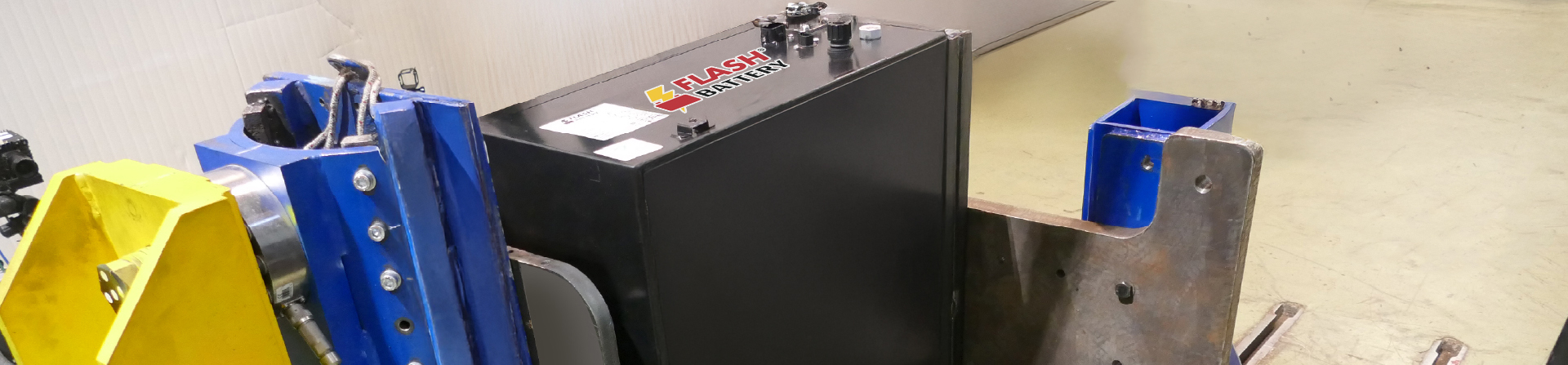
Mechanical testing of a Flash Battery battery during the ECE R100 certification process

Flash Battery battery subjected to a fire exposure test in accordance with ECE R100 requirements.
Electrical tests simulate fault conditions such as short circuits, overcharging, and overcurrent events. In each case, the battery must react in a controlled manner, preventing dangerous situations.

Verification of the integrity and safety of Flash Battery under vibration testing in accordance with ECE R100 requirements.
Among all the tests, the most significant is the thermal propagation test, which simulates an internal cell failure and evaluates the system’s ability to prevent propagation. This test involves every aspect of battery design, including cell arrangement, materials, thermal management systems, and control strategies.
The Thermal Propagation Test

Testing battery resistance to extreme temperature fluctuations
Among all tests required by ECE R100, the Thermal Propagation Test is currently one of the most important.
The test simulates the failure of a single cell and verifies that the event does not spread uncontrollably throughout the battery pack.
Results depend on the entire design approach, including cell configuration, insulation materials, heat dissipation systems, BMS control strategies, and overall battery architecture.
With the introduction of Rev.5, this verification will become even more central, extending to the entire battery pack and introducing stricter requirements for managing thermal runaway events.
ECE R100 homologation is not a test— it’s a process
The complexity of the tests required by the regulation highlights a frequently underestimated reality: ECE R100 homologation is not a milestone to be achieved at the end of battery development, but a process that must guide the entire design phase.
Integrating regulatory requirements from the earliest stages reduces design modifications, rework, and validation time while increasing the likelihood of passing tests on the first attempt.
For this reason, compliance requires multidisciplinary expertise and close collaboration between mechanical design, electronics development, software engineering, production, testing, and quality assurance teams.
Conformity of Production (CoP) also plays a crucial role. It is not enough to prove that a prototype passes regulatory tests; manufacturers must ensure that every battery produced maintains the same safety and quality standards
“Compliance is not the result of a single test but the outcome of coordinated and continuous work involving multiple company functions. It starts with the initial design phase, where regulatory requirements must be incorporated into technical decisions, continues through production—with particular attention to Conformity of Production—and extends through testing, validation, technical documentation, and final approval. For this reason, homologation must be approached as a process that begins with design and accompanies the entire product development cycle.”

Custom batteries and ECE R100 Certification: are tailor-made design and homologation really compatible?
In the industrial vehicle sector, there is still a common misconception that a custom-designed battery is more difficult to homologate than a standard solution.
In reality, the regulatory pathway remains the same. It is not customisation itself that complicates certification, but rather how the battery is designed. A custom battery starts from the vehicle’s specific application requirements, enabling critical aspects—including regulatory compliance—to be optimized from the very beginning.
When properly managed, this approach can actually simplify the homologation process rather than complicate it.
Within this framework, the Battery Management System (BMS) plays a vital role in meeting the safety requirements defined by ECE R100. The BMS continuously monitors parameters such as voltage, current, and temperature, intervening in real time whenever abnormal conditions are detected by activating the necessary protection strategies.
Beyond improving operational safety during vehicle use, properly designed control logic is also crucial during homologation testing, where battery behavior is evaluated under fault conditions and extreme scenarios.
For custom battery solutions, a proprietary Battery Management System allows control strategies to be perfectly aligned with both battery architecture and application requirements. In Flash Battery’s case, the Flash Balancing System actively manages cell balancing, continuously monitoring battery pack status and optimizing performance throughout its entire lifecycle.
This integration of hardware and software improves battery reliability and helps maintain controlled operation even in conditions that could otherwise compromise system safety.
Battery safety depends not only on component quality but also on the ability to detect anomalies at an early stage.
To further strengthen this approach, Flash Battery developed a patented technology that integrates Electrochemical Impedance Spectroscopy (EIS) into the BMS, enabling more accurate monitoring of cell health and early detection of potential abnormalities.
This increases the ability to prevent critical situations and degradation phenomena while ensuring more controlled battery behavior, even under extreme conditions.
In industrial applications, battery safety never depends on a single component. It is the result of the integration of mechanical design, control electronics, management software, and advanced monitoring systems working together to prevent, detect, and manage abnormal conditions.

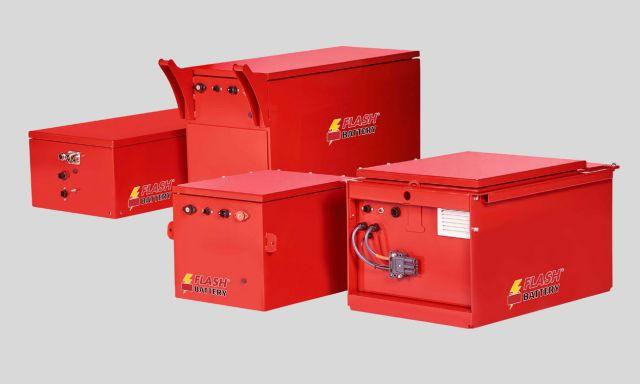
Flash Battery custom lithium battery designed for integration into electric vehicles and developed in compliance with application-specific and safety requirements defined by the manufacturer.