






Aerosol fire suppression systems for lithium batteries: how they work and why they improve safety
31 August 2026
In recent years, lithium-ion batteries have established themselves as a key technology for numerous industrial applications, from electric vehicles to energy storage systems (BESS). Their performance in terms of energy density, efficiency, and lifespan makes them a central component of electrification processes.
However, this high concentration of energy also requires a rigorous approach to safety design. More energy means greater performance, but it also demands careful management of operating conditions and potential anomalies.
In this context, aerosol fire suppression systems provide an additional layer of protection. These devices are designed to respond rapidly when a fire starts inside a battery enclosure or other closed compartment, helping to limit its spread. It is important to note, however, that they do not stop thermal runaway itself; rather, they act on the combustion phase.
The safety of a lithium battery does not depend on a single component, but on a combination of design choices involving cell chemistry, cell assembly, and battery management electronics.
It is within this broader approach that additional protection devices, such as aerosol fire suppression systems, can be integrated to intervene should a fire occur. To understand their role, it is essential to clearly distinguish between two phenomena that are often confused: thermal runaway and fire.
The safety of a lithium battery does not depend on a single device, but rather on a design strategy that integrates prevention, monitoring, and anomaly management.
Flash Battery has adopted an active safety approach aimed at detecting early warning signs of anomalies and reducing risk before they develop into critical conditions. These warning signs include abnormal temperature variations and the presence of gases generated within the battery pack.
The first level of safety lies in the battery system design itself. Selecting the most suitable chemistry for the application, correctly sizing the battery pack, ensuring high-quality cell assembly, and implementing robust control electronics all contribute to reducing risk at its source.
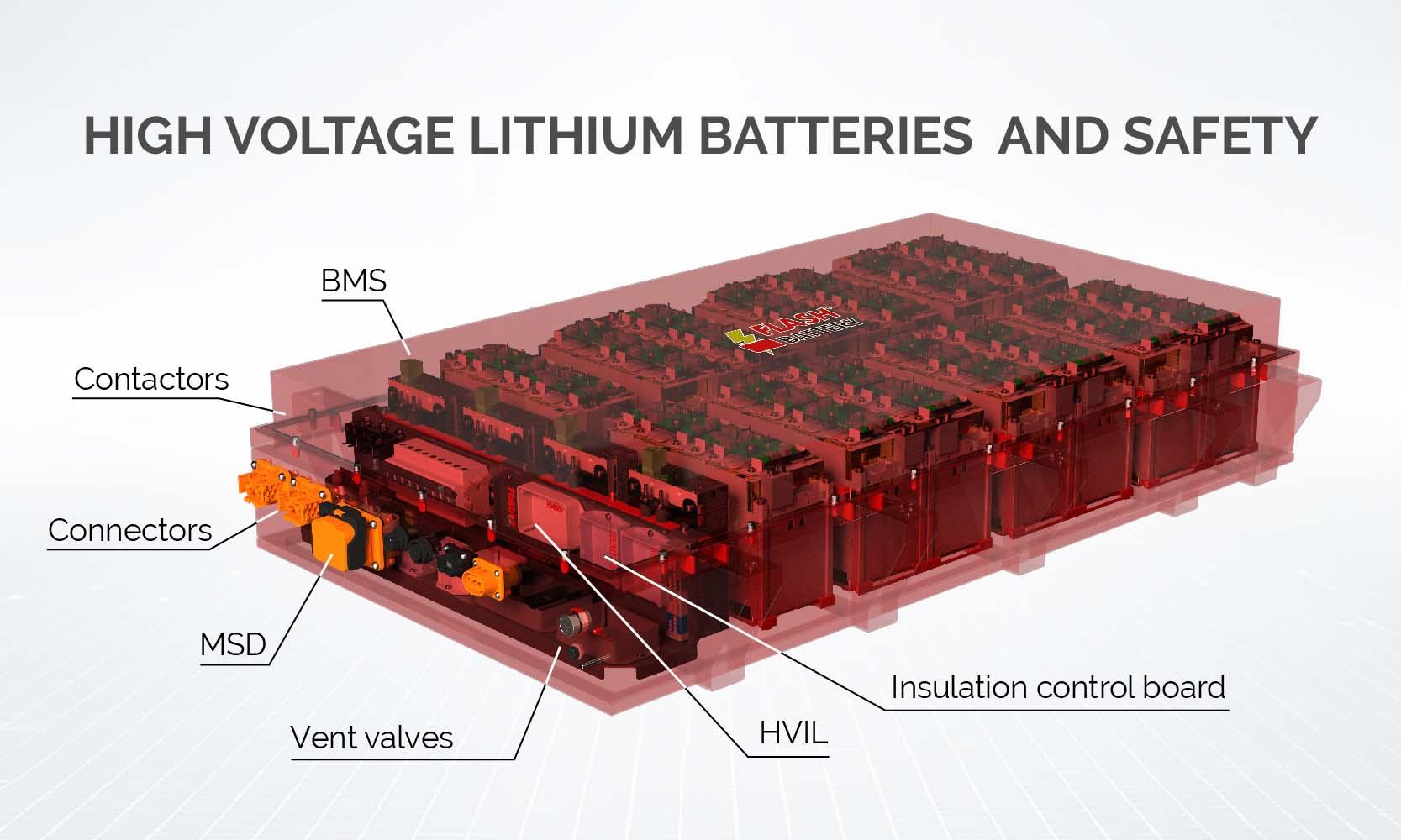
Building on this foundation is the Battery Management System (BMS) which continuously monitors key parameters such as cell voltage, current, and temperature. Through dedicated algorithms, the BMS maintains the system within its intended operating conditions, helping to prevent potentially critical situations.
This level of control is complemented by advanced monitoring tools such as gas sensors already adopted by Flash Battery. These sensors enable early detection of potentially hazardous conditions, allowing targeted intervention before more complex events develop. The goal is twofold: minimize the likelihood of critical conditions and manage any anomalies in a controlled and timely manner.
Alongside monitoring systems, additional protection devices can be installed to respond should a fire start. This is where aerosol fire suppression systems come into play. They are designed to intervene during the initial stages of combustion and rapidly limit fire propagation.
The effectiveness of a safety strategy comes precisely from integrating these different layers: sound design, continuous monitoring, and complementary protection systems working together to reduce risk and manage anomalous events as safely as possible.

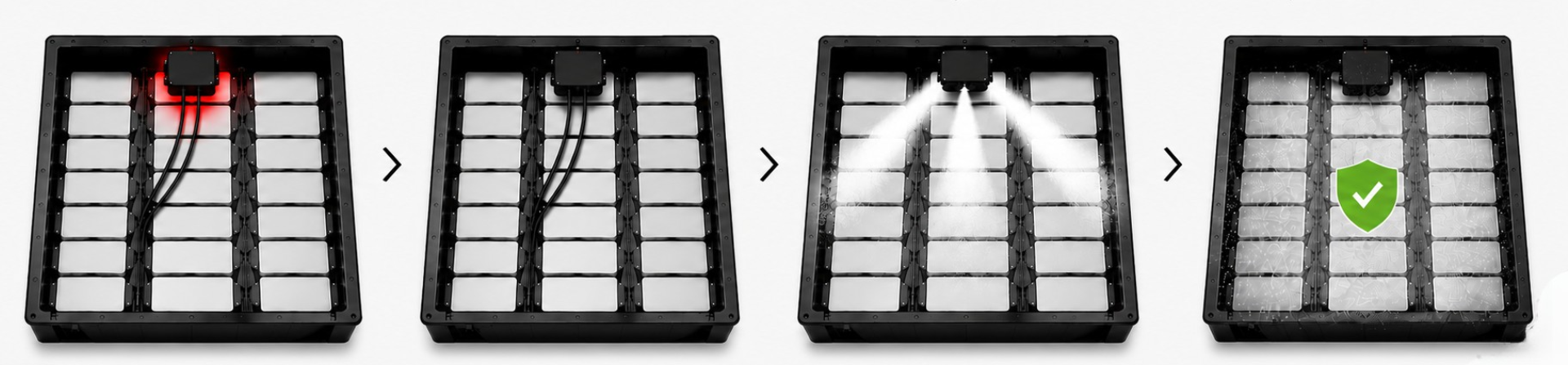
How an aerosol fire suppression system integrated into a lithium battery works to contain an incipient fire.
Advantages over traditional solutions
Aerosol suppression systems offer a range of tangible benefits that make them particularly suitable for industrial applications and energy storage systems (BESS).
One of their main strengths is the speed of response: activation takes place within seconds of detecting a thermal anomaly, a crucial factor when dealing with events such as thermal runaway, which can evolve very quickly.
Furthermore, the ability to operate in enclosed, complex spaces makes aerosol an ideal solution where pressurised or water-based systems cannot be used or would be harmful. The absence of pressurisation and the compact size of the devices simplify integration into modular architectures.
There is also an additional advantage: the suppressing agent leaves no harmful residue, protecting the integrity of power electronics and reducing restoration times after an event.
Finally, it’s a safe solution from an environmental perspective as well: the suppressing agent is halon-free, non-toxic and compliant with the Montreal Protocol. In terms of integrated and sustainable safety, aerosol is therefore a technologically advanced and highly effective choice.

Comparative table of traditional extinguishing systems: condensed aerosol, inert gases, and water mist, evaluated in terms of activation times, penetration capability, and collateral damage.
How we integrate aerosol fire suppression systems into flash battery packs
From a design standpoint, the integration of aerosol fire suppression systems is sized according to the specific characteristics of the battery pack, particularly its internal volume and the geometry of the areas to be protected.
Within Flash Battery solutions, devices are installed in a distributed configuration, with multiple units used within the same battery pack when necessary.
This approach ensures uniform coverage even in large battery systems or complex internal layouts, where compartmentalization or longer distances might reduce the effectiveness of a single intervention point.
Activation occurs automatically when a predefined temperature threshold is exceeded. The device then releases the extinguishing agent directly into the protected volume, enabling rapid and localized intervention.
Typically, each device is designed to protect volumes ranging from approximately 0.2 to 0.6 m³, with the standard Flash Battery configuration averaging around 0.4 m³ per unit.
The number and positioning of the devices therefore become an integral part of the overall safety design of the system.