






Flash Data Center: how data helps anticipate lithium battery anomalies
21 October 2026
In electrified industrial applications, monitoring the performance of lithium batteries is essential to ensure reliability and operational continuity. However, collecting data alone is not enough. The real value comes from the ability to interpret it, identify potential anomalies, and turn it into actionable insights for battery management and maintenance.
When a battery exhibits anomalous behavior, responding quickly is important. Being able to identify a potential issue before it impacts operations is even more critical. This is the challenge faced today by OEMs, system integrators, and industrial users managing fleets of electric vehicles and increasingly connected equipment.
This is precisely the principle behind the Flash Data Center, Flash Battery’s proprietary platform designed to remotely collect and analyze operational data from industrial lithium batteries, providing OEMs, system integrators, and end users with deep visibility into battery operating conditions.
Today, thanks to the continuous evolution of its features, Flash Data Center goes far beyond simple monitoring. From State of Health (SOH) analysis and cell internal resistance evaluation to the implementation of Machine Learning and Anomaly Detection models, the platform helps identify potential signs of degradation and abnormal behavior, supporting an increasingly predictive approach to maintenance.
But how is this data analyzed? And how can it help improve battery reliability, optimize maintenance planning, and reduce the risk of unexpected downtime?
How battery monitoring works with Flash Data Center
Every connected battery continuously generates operational data, including temperatures, voltages, currents, state of charge, duty cycles, and many other parameters monitored by the Battery Management System.
Taken individually, these data points are simply technical information. Their real value emerges when they are organized and interpreted to understand battery behavior, support technical assistance activities, and drive more informed operational decisions.
When Flash Data Center was developed in 2013, the concept of connected batteries was still in its early stages within the industrial sector. Yet the objective was already clear: to create an infrastructure capable of leveraging the wealth of data generated by batteries and making it immediately accessible to both customers and technical teams.
Today, despite the platform's evolution and the introduction of increasingly advanced features, Flash Data Center continues to be built on two fundamental pillars: centralized data collection and remote battery connectivity.
This combination of data acquisition, connectivity, and analytics forms the foundation of all advanced platform capabilities, from fleet visualization to the latest predictive maintenance applications.
A single platform to monitor your entire battery fleet
Through Flash Data Center, OEMs, system integrators, and industrial users can monitor all connected batteries from a single environment, regardless of their geographical location or application.
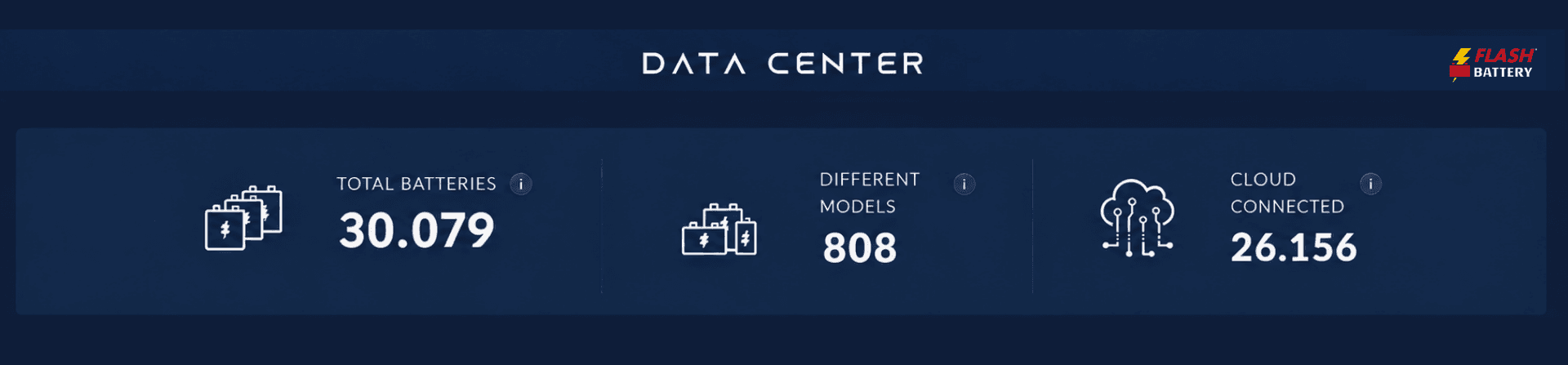
The centralized dashboard provides a comprehensive overview of the entire battery fleet, displaying the number of installed batteries, systems currently connected to the cloud, total energy delivered, completed charge cycles, and battery distribution across different locations.
This holistic view ensures that key operational information is always available, simplifying battery fleet management even when systems are distributed across multiple facilities and geographic areas.

Flash Data Center dashboard providing an overview of connected batteries, key operating parameters, and their geographical distribution.
Comparing batteries to identify abnormal behaviour
Having access to thousands of battery operating data points is extremely valuable. However, to truly understand what is happening, another element must be considered: the operating context.
The same battery may operate under significantly different conditions depending on its application, installation environment, ambient temperatures, production schedules, and vehicle or machine usage patterns. As a result, analyzing data in isolation can be misleading.
To address this challenge, Flash Data Center allows users to group batteries by plant location or logical operating groups, creating an analytical model that reflects real operating conditions. For example, batteries installed in the same automated warehouse, airport, or rental fleet can be compared to determine whether their behavior remains consistent under shared operational conditions.

Comparative analysis of battery operating parameters within Flash Data Center, highlighting behavioural differences across batteries belonging to the same fleet.
Consider a fleet of ten airport vehicles operating under the same working conditions. If nine batteries record similar temperature profiles while one consistently exhibits significantly higher values, comparative analysis immediately highlights a deviation that may require further technical investigation.
The causes may vary. For example, there could be an obstruction affecting heat exchange with the external environment, a malfunction in the battery cooling system, or simply a protective cover that has been removed, exposing the battery directly to sunlight.
The same analytical approach can be applied to other parameters, including usage profiles, charging and discharging times, and state-of-charge trends over time. Comparative analysis is one of the most valuable applications lithium batteries’ remote monitoring because it allows operating data to be interpreted within its real context, highlighting behavioral differences between batteries operating in the same fleet and supporting subsequent technical assessments.

A summary list that compares the operating parameters of all batteries in the same fleet to identify anomalies and differences in behaviour.
State of Health: monitoring battery health over time
Among the most important indicators for assessing lithium battery condition is the State of Health (SOH), a metric that describes the battery's overall health status compared to its original reference condition and enables degradation trends to be monitored over time.
Through Flash Data Center, users can analyze the SOH evolution of installed batteries, obtaining valuable insights into system aging and verifying whether battery performance continues to meet application requirements.
This analytical capability is particularly important in industrial environments, where operational continuity depends on the ability to plan maintenance activities effectively. Monitoring SOH trends makes it possible to identify batteries approaching critical performance thresholds and schedule corrective actions in advance.
For users, this means maximizing battery utilization while it continues to meet operational requirements, avoiding premature battery replacements. For OEMs and system integrators, it enables more effective spare parts planning and technical intervention scheduling, reducing the likelihood of unexpected maintenance situations.
This advantage is particularly relevant in continuous-operation industrial environments or geographically distributed installations, where even a single instance of unplanned downtime can significantly affect productivity.

Distribution of batteries within a facility by State of Health (SOH) ranges, displayed in Flash Data Center to monitor overall fleet health.
Internal Resistance: what it reveals about cell aging
To understand how the health of a lithium battery evolves over time, one of the most meaningful parameters to analyze is internal resistance, namely the resistance a battery opposes to electrical current flow. Its evolution can provide valuable information about cell aging mechanisms and operating conditions.
Thanks to data collected by our proprietary Battery Management System, the Flash Balancing System, Flash Data Center can monitor internal resistance trends over time and use this information as a key indicator for assessing battery health with greater accuracy.
One of the most valuable aspects of this feature is the depth of analysis it enables. Rather than focusing solely on overall battery performance, the platform allows users to analyze the internal resistance of individual cells, making it easier to identify cell-level degradation patterns.
For example, if one cell exhibits a significantly higher increase in internal resistance than the rest of the battery pack, the system can immediately identify the deviation and flag a condition worthy of deeper technical investigation.
Internal resistance analysis therefore makes it possible to detect early signs of degradation that may not be visible through overall battery-level indicators alone. This information helps improve understanding of battery health evolution and supports assessments of remaining useful life.

Internal resistance analysis in Flash Data Center, including historical trends, forecasts, and detected deviations between cells.
“The true value of Flash Data Center lies in its ability to analyse and correlate operational data collected from batteries over time. The integration of Machine Learning models and Anomaly Detection techniques enables us to gain deeper insight into the evolution of key parameters, such as internal resistance, and identify deviations from expected behaviour even before traditional alarm thresholds are reached. This approach allows us to transform data into actionable diagnostic information and support increasingly predictive maintenance strategies.”